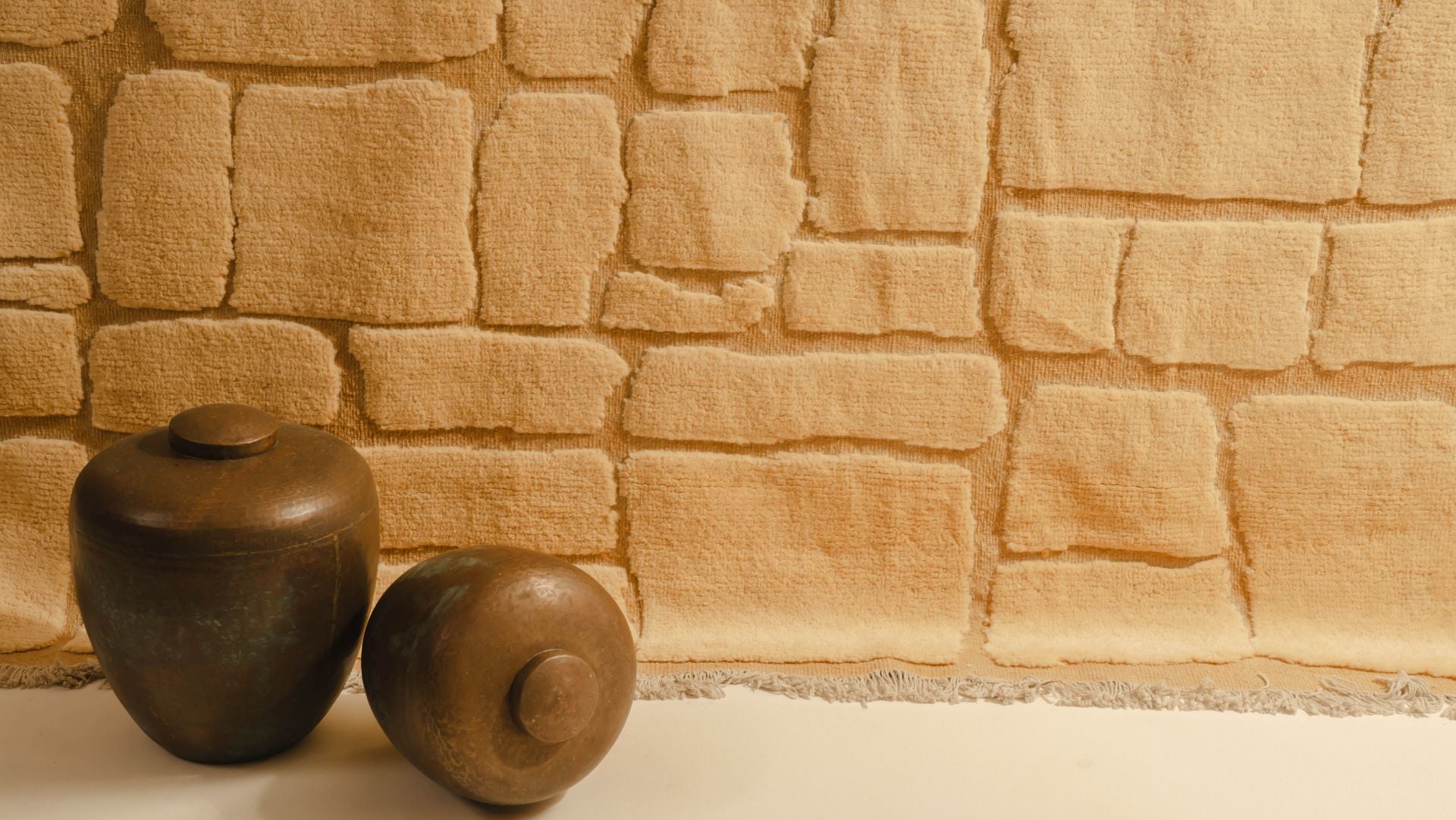
A kilim rug is a flat-woven rug. It has no pile, so there is nothing standing up from a backing: the pattern is built into the weave itself and shows on both faces. That one fact explains most of what makes a kilim different from a knotted or tufted rug.
The short answer
A kilim is made by passing weft threads over and under fixed warp threads until the pattern builds up. It is thin, light and looks the same on the back. We list handwoven wool kilim rugs from 60 x 90 cm up to oversized, and runners from 150 cm to 500 cm long.
How a kilim is woven
Every woven rug has two sets of threads. The warp runs the length of the rug and is held under tension on the loom. The weft passes across it, over and under, side to side. In a kilim the weft is packed down so tightly that it covers the warp completely. The weft is the pattern: each coloured area is a block of weft thread worked back and forth in its own space.
In many kilims, where one colour block meets the next, the weaver turns the weft back on itself and leaves a small slit. Look closely at a diagonal line in a kilim and you can often see the tiny steps and gaps this makes. It is one of the plainest signs of how the rug was made.
A knotted rug is built differently. Short lengths of yarn are tied round the warp one knot at a time, and the cut ends stand up to form the pile. A tufted rug has yarn punched through a stretched backing. A kilim has neither, which is why it is called a flatweave. Kilims are one family of flatweave rugs, and what a flatweave rug is explains the wider group.
How to tell a kilim from a pile rug
- Turn it over. A kilim looks the same on the back. A pile rug shows its knots or a plain backing.
- Run your hand across it. A kilim is smooth and flat. A pile rug has a raised surface you can part with your fingers.
- Look at the ends. In a kilim the fringe is the warp threads themselves, running straight out of the weave.
- Feel the weight. A kilim is thin and light and folds easily. A pile rug of the same size is thicker and heavier.
A printed or machine-made rug sold as kilim-style usually has a plain backing and the design on one side only. Turn it over and you will see the difference.
Where kilims come from
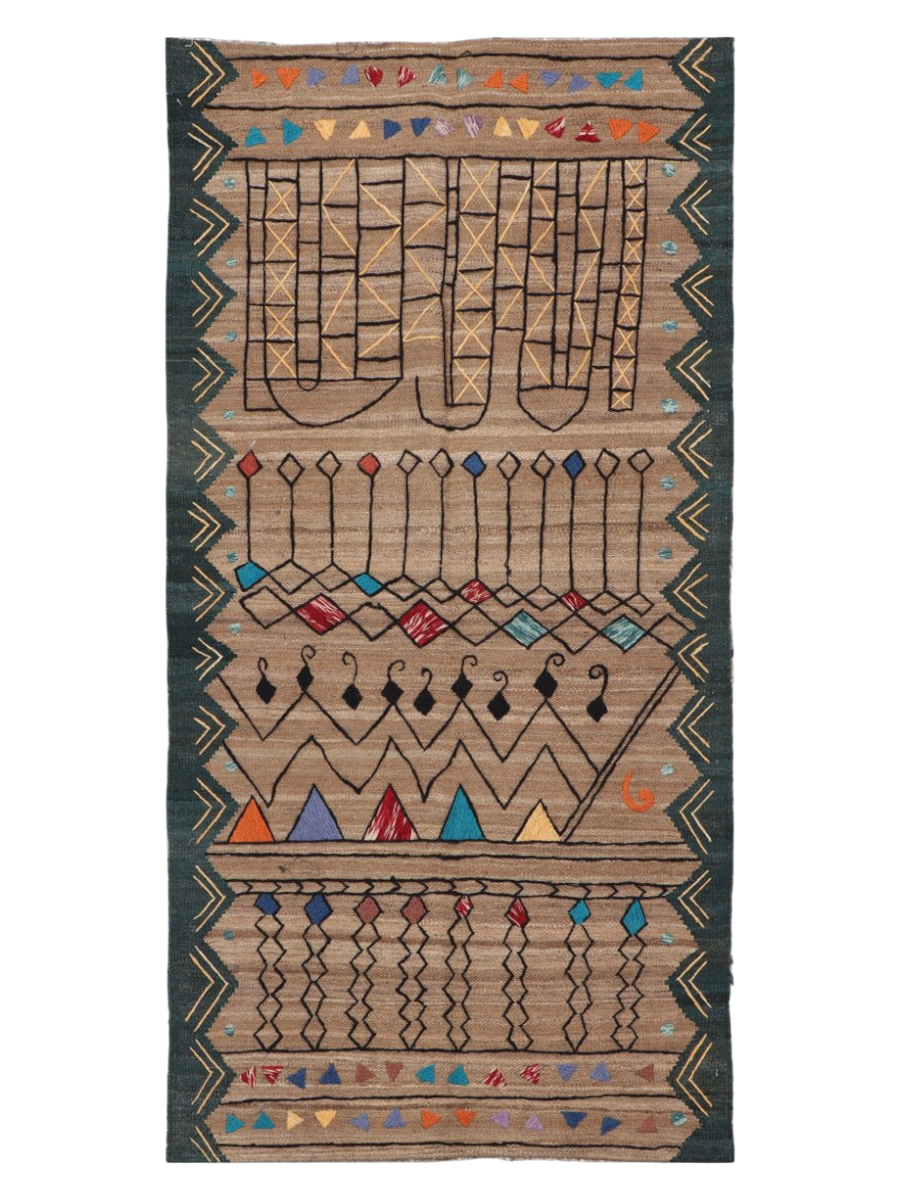
Flatweaves are made across a wide arc of Asia and North Africa: Anatolia, the Caucasus, Persia, Central Asia and Afghanistan. Each area has its own weaving habits, colour ranges and drawing. Our wool kilims are woven mostly in Maimana, in Afghanistan, and each listing names where the rug was made. Our guide to what a Maimana kilim is goes through the region and its patterns, and you can browse the Afghanistan kilim rugs woven there.
What the patterns mean
Kilim patterns are not decoration alone. Diamonds, hooks, stepped lines and stripes have been woven for generations and carry meaning from one region and family to the next. Meanings differ, and we do not want to flatten them into a single list. Read the story and meaning of kilim rugs for the history behind the patterns.
Where a kilim works
Because a kilim has no pile to flatten, it takes shoes and daily walking in a way that suits halls, stairs, kitchens and dining rooms. It also lies flat under doors. For a long, narrow space, browse kilim runners.
How to choose one
Start with the size in cm, then the room, then the colours. Our guide on how to choose a kilim rug covers each step. Most of our kilims are one of one: when a piece sells, it is not restocked.
How to look after one
A kilim is easy to vacuum, because it is thin and light. For spills, rotation and sun, see how to clean a kilim rug.
Questions we get asked
What is a kilim rug?
A kilim is a flat-woven rug with no pile. The weft threads are woven over and under the warp, so the pattern shows on both faces.
What is the difference between a kilim and a normal rug?
A normal pile rug has knotted or tufted yarn standing up from a backing. A kilim is flat and the design is woven into the structure, so it is thinner and looks the same on both sides.
Are kilim rugs reversible?
Yes. The pattern shows on both faces, so you can use either side up. Turning the rug over every few months also spreads wear.
Are kilims made by hand?
Many are. Ours are handwoven in wool, and each listing says where the rug was made. Browse the full kilim rug range.